

Physical Description & Life History
Physical Description
Trademark Features
Image: below, drawing depicting the size of the southern aardwolf sourced from Dimensions.com (Dimensions, n.d).

Size
The southern aardwolf is smaller than the average hyena, weighing in at 8-12 kg (Koehler and Richardson, 1990). From late summer to late winter, the aardwolf's size decreases by around 61 g per month due to a reduction in termite availability (Anderson, 2004).
Image: below, image of the southern aardwolf showing its erect fluffy mane and striped coat (Withers-Clarke, n.d).

Coat
The southern aardwolf has a long, luscious mane that extends from head to tail and is the longest in their shoulder region (Koehler and Richardson, 1990). Their hairs alternate in colour, creating a somewhat striped appearance, and taper off to give the face a grey, short-haired look, with a hairless muzzle (Koehler and Richardson, 1990)
Image: below, the southern aardwolf sticking it tongue out, where its large conical and incisor papillae can be seen (Tambako the Jaguar, 2014).

Tongue
A unique and distinctive feature of the aardwolf is their wide tongue, covered in large conical papillae (Anderson et al., 1992). These papillae help reduce the amount of sand ingested during feeding and protect the tongue from the abrasiveness of the sand (Anderson et al., 1992).

Figure 1. Image taken by Withers- Clarke (2021) of the southern aardwolf, made into a diagram and labelled to highlight its unique features. Information sourced from Koehler and Richardson (1990)
Common questions about aardwolf morphology and life history
Explore key facts regarding the physical traits, seasonal weight variations, reproduction, and lifespan of the southern aardwolf (Proteles cristata).
Life history
Reproduction
Late June: Female aardwolves enter proestrus
Early July: Aardwolves mate and are socially monogamous, so typically 1 male per 1 female (Kotze et al., 2012)
October - December: The aardwolf has a gestation period of 90 days, then typically gives birth anytime around October to December (Koehler and Richardson, 1990)
Cubs
An average of 2-4 altricial cubs (Stump, 2011) are born per litter inside their respective den and venture out after 1 month (Koehler and Richardson, 1990)
6-9 wks: Cubs start to play outside, but do not venture far (Koehler and Richarson, 1990)
9-12 wks: Start to learn how to forage with the adults and eat some termites, but still do not venture far (Koehler and Richardson, 1990)
4 months: The cubs are weaned (Jaarsveld et al., 1995)
1 year: Start to venture to other territories, and eventually leave their natal territories to find their own (Koehler and Richardson, 1990)
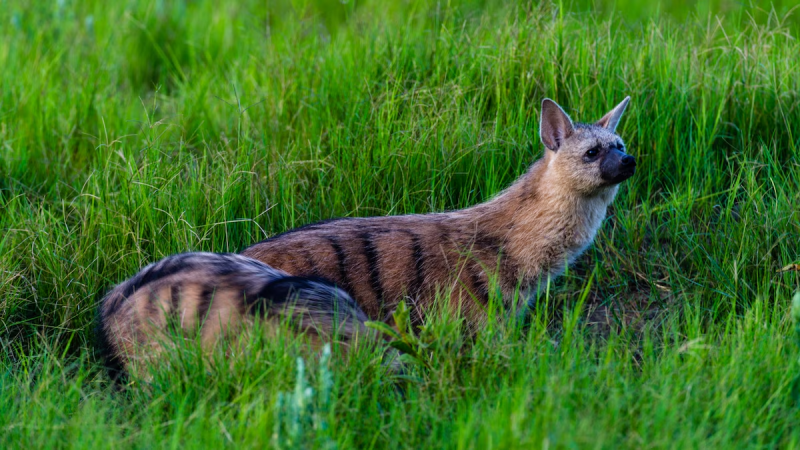
Image: above, a southern aardwolf and her young. Photograph by Jason Edwards, National Geographic (n.d.)
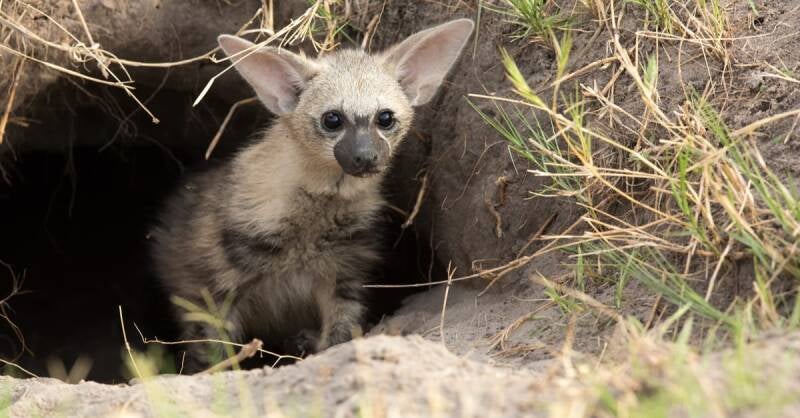
Image: above, young aardwolf emerging from the den. Photographed by Thomas Retterath (n.d).
(Christian, 2014)